

Disclosure: This post contains affiliate links. If you purchase through my link, I may earn a small commission at no extra cost to you.
By an Adventure mom who summited Kilimanjaro not twice, but three times.


A Quick Lesson Learned the Hard Way
During my first Kilimanjaro attempt in 2022, I made a rookie mistake; I left my hiking boots at home after six months of training with them. Only one person in our group knew about my predicament, and I was lucky enough to rent boots in Tanzania. That’s when I truly understood the saying “good gear won’t take you up the mountain—it’s your mindset.” I made it through the storms and rough terrain just fine, proving that while quality gear improves your experience, determination is what gets you to the summit.
But here’s my biggest takeaway: Always pack your hiking boots and summit gear in your carry-on! You can replace most lost items, but properly fitted boots are irreplaceable when you’re already at base camp.
Whether you’re lacing up your first pair of hiking boots or gearing up to climb one of the world’s greatest mountains, one thing is non-negotiable: your boots have to work for you. They need to keep your feet dry, grip the terrain, and let’s be honest—look good too. Nobody is sacrificing style in 2026. I’ve climbed Kilimanjaro three times, on two different routes, in two different La Sportiva boots. Here’s everything I learned, and which boot is right for where you are in your hiking journey right now.
First, Let’s Talk About Gore-Tex — And Why It’s a Must


If you’re new to hiking, you may have seen the term Gore-Tex on boots and wondered what it means. Simply put, Gore-Tex is a waterproof lining built inside the boot that keeps water out while still letting your feet breathe. Rain, puddles, wet grass, none of it gets through.
I always tell women: if your hiking boot doesn’t have Gore-Tex, keep shopping. Wet feet on the trail mean blisters, cold, and misery. It’s the one feature I refuse to compromise on, whether I’m doing a local trail or climbing a glacier in Africa. Both boots in this review are Gore-Tex. Both will keep your feet dry. But they’re built for different levels, and that matters.
The Beginner-Friendly Pick: La Sportiva Ultra Raptor II Mid Leather GTX Women’s-Retail: $219
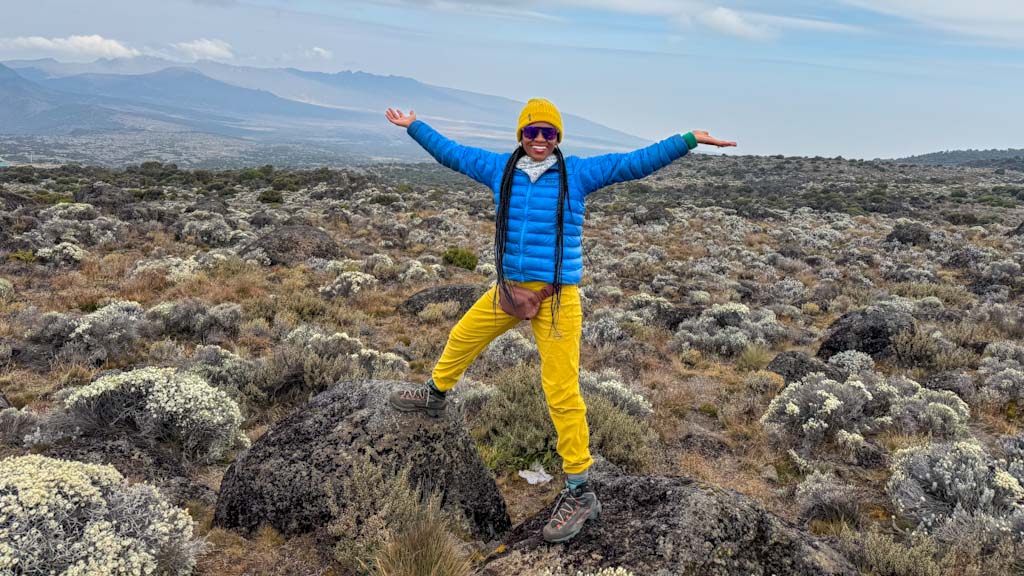
If you’re getting into hiking and want a boot that’s lightweight, stylish, and ready for anything the trail throws at you, start here. I wore the Ultra Raptor II Mid Leather GTX on my Kilimanjaro climb via the Rongai Route, a more gradual approach with beautiful scenery and no major technical scrambling. It rained on that hike, and I mean really rained. We hiked through it for hours, and my feet stayed completely dry the entire time. That Gore-Tex lining delivered exactly what it promised.
What I loved most was how light these boots felt. For a mid-cut hiking boot with full waterproofing, they’re surprisingly nimble on your feet, which means less fatigue on longer hikes. And the style? Everyone on the mountain noticed them. I got more compliments on these boots than anything else in my kit. That matters because when you feel good in what you’re wearing, you hike better.
The FriXion Red outsole grips well on wet and rocky terrain, making it a reliable choice for beginner-to-intermediate trails, rainy hikes, and multi-day treks. My only honest note: the leather construction can feel a little stiff, especially on longer summit days. But for a first boot or an everyday trail boot, the Ultra Raptor is a fantastic choice, and I didn’t have to break them in at all.
💰 Price tip: These retail at $219, but keep an eye out — I’ve seen them drop to as low as $142.35! You can check the current sale price here.
The “I’m Ready for More” Upgrade: La Sportiva Aequilibrium Hike GTX Women’s-Retail: $279
Once you’ve fallen in love with hiking and you’re ready to tackle bigger, more technical mountains, this is your boot.
I wore the Aequilibrium Hike GTX on my third Kilimanjaro climb, and this route was a completely different animal. We faced three totally different terrains in one climb: extreme heat and sandy trails, the infamous Barranco Wall — a massive rock face where you’re literally scrambling with your hands and feet — and finally, a glacier summit covered in ice and snow.
If you don’t know about the Barranco Wall, know this: it is no joke. You need serious traction and a boot you can trust with your life. The Aequilibrium didn’t hesitate for a second. The grip on that rock face was incredible — confident and stable on every move.
This boot differs from the Ultra Raptor in that it has a higher platform, providing more stability and control on rough terrain. On the glacier after the wall, that platform proved vital. Gore-Tex protected my feet through sand, rock, and ice. Hours later, I loved these boots — revealing their quality. Ideal for women committed to high-altitude hikes, glacier routes, or demanding mountains.
💰Check current pricing and deals here
So Which Boot Is Right for You?
Get the Ultra Raptor II Mid if: You’re new to hiking, want something lightweight and stylish, need a reliable waterproof boot for trails and rainy hikes, or are looking for a great deal on a premium boot.
Get the Aequilibrium Hike GTX if: You’re planning Kilimanjaro, tackling technical or high-altitude terrain, or you’re ready to invest in a boot built for serious mountains.
Either way, you’re choosing a boot that will keep your feet dry, grip the terrain, and turn heads on the trail. Because in 2026, there’s no reason your hiking boots can’t do both. Your feet carry you to the summit. Invest in them.
Planning your first hike or have questions about gearing up for Kilimanjaro? Drop them in the comments below — I’ve been there, literally.
Share this:

Discover more from Wisconsin Adventure Family
Subscribe to get the latest posts sent to your email.
